
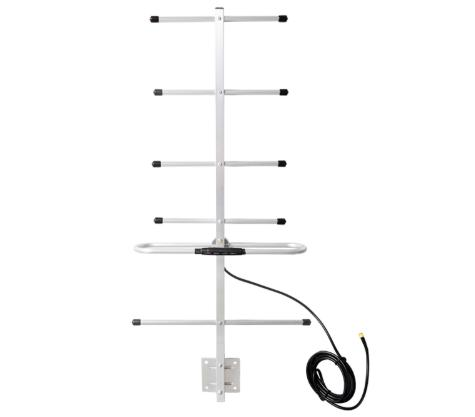
A side-by-side table of every stacking yagi antenna in the catalog, sorted so the gain-versus-size trade-off is visible at a glance. Higher gain on the same band always costs aperture length, and on a mast that length is a wind-load number, not a footnote.
The trade-off in one sentence
Between the smallest and largest model here the gain moves from 1 to 23 dBi while the longest dimension moves from 3 mm to 2570 mm. That is the whole negotiation: roughly every 3 dB of additional gain doubles the effective radiated power in the main lobe and costs about twice the aperture.
Full comparison
| Model | Band (MHz) | Gain | Polarization | HPBW H×V | VSWR | IP | Length | Connector |
|---|---|---|---|---|---|---|---|---|
| AW-YG0890-18 | 824–960 | 18 dBi | Vertical | 30° × 25° | ≤ 1.5:1 | IP65 | 1290 mm | N-Female |
| AW-YG0450-12 | 450–470 | 12 dBi | Vertical | 42° × 38° | ≤ 1.5:1 | IP65 | 870 mm | N-Female |
| AW-YG0890-12 | 824–960 | 12 dBi | Vertical | 48° × 40° | ≤ 1.5:1 | IP65 | 465 mm | N-Female |
| AW-YG2400-18 | 2400–2483 | 18 dBi | Vertical | 30° × 28° | ≤ 1.5:1 | IP65 | 580 mm | N-Female |
| AW-YG1922-16 | 1720–2170 | 16 dBi | Vertical | 35° × 30° | ≤ 1.5:1 | IP65 | 610 mm | N-Female |
| AW-YG0433-12 | 428–438 | 12 dBi | Vertical | 42° × 38° | ≤ 1.5:1 | IP65 | 920 mm | N-Female |
| AW-PA7090-V18B65 | 698–960 | 18 dBi | Vertical | 65° × 7° | ≤ 1.5:1 | IP65 | 2570 mm | N-Female |
| AW-PA7090-V15B65 | 698–960 | 15 dBi | Vertical | 65° × 15° | ≤ 1.5:1 | IP65 | 1360 mm | N-Female |
| AW-LP4386-13 | 430–860 | 13 dBi | Vertical | 45° × 40° | ≤ 2.0:1 | IP65 | 1450 mm | N-Female |
| AW-FG0890-12 | 824–890 | 12 dBi | Vertical | 360° × 5° | ≤ 1.5:1 | IP67 | 1550 mm | N-Female |
| AW-PA7090-V12B65 | 698–960 | 12 dBi | Vertical | 65° × 30° | ≤ 1.5:1 | IP65 | 720 mm | N-Female |
| AW-PA7090-V11B90 | 698–960 | 11 dBi | Vertical | 90° × 30° | ≤ 1.5:1 | IP65 | 720 mm | N-Female |
| AW-PA7090-V10B120 | 698–960 | 10 dBi | Vertical | 120° × 30° | ≤ 1.5:1 | IP65 | 720 mm | N-Female |
| AW-WM0912-9 | 902–928 | 9 dBi | Vertical | 65° × 40° | ≤ 1.5:1 | IP65 | 210 mm | N-Female |
| AW-GUN0827-5 | 698–2700 | 5 dBi | Vertical | 360° × 40° | ≤ 2.0:1 | IP65 | 230 mm | N-Female |
| AW-HH0400-2 | 400–470 | 2 dBi | Vertical | 360° × 60° | ≤ 2.0:1 | IP54 | 160 mm | SMA-Female |
| AW-PA7090-X2x15B65 | 698–960 | 2x15 dBi | Dual ±45° slant | 65° × 15° | ≤ 1.5:1 | IP65 | 1360 mm | N-Female |
| AW-PA7090-X2x18B65 | 698–960 | 2x18 dBi | Dual ±45° slant | 65° × 7° | ≤ 1.5:1 | IP65 | 2570 mm | N-Female |
| AW-HH-VU-STUBBY | 136–470 | 1 dBi | Vertical | 360° × 65° | ≤ 2.5:1 | IP54 | 48 mm | SMA-Female |
| AW-PA8090-V18B65 | 806–960 | 18 dBi | Vertical | 65° × 7° | ≤ 1.5:1 | IP65 | 2430 mm | N-Female |
| AW-TV-UHF-17 | 470–862 | 17 dBi | Horizontal | 32° × 28° | ≤ 2.5:1 | IP54 | 1250 mm | F-Female |
| AW-PA8090-V15B65 | 806–960 | 15 dBi | Vertical | 65° × 15° | ≤ 1.5:1 | IP65 | 1300 mm | N-Female |
| AW-LP0838-12 | 800–3800 | 12 dBi | Vertical | 50° × 42° | ≤ 2.0:1 | IP65 | 760 mm | N-Female |
| AW-PA8025-H12B65 | 806–2500 | 12 dBi | Horizontal | 65° × 30° | ≤ 1.5:1 | IP65 | 660 mm | N-Female |
| AW-PA8025-V12B65 | 806–2500 | 12 dBi | Vertical | 65° × 30° | ≤ 1.5:1 | IP65 | 660 mm | N-Female |
| AW-PA8090-V12B65 | 806–960 | 12 dBi | Vertical | 65° × 30° | ≤ 1.5:1 | IP65 | 700 mm | N-Female |
| AW-TV-VU-12 | 174–862 | 12 dBi | Horizontal | 45° × 38° | ≤ 2.5:1 | IP54 | 980 mm | F-Female |
| AW-ID0827-11 | 698–2700 | 11 dBi | Vertical | 65° × 55° | ≤ 1.5:1 | IP40 | 295 mm | N-Female |
| AW-LP0827-11 | 698–2700 | 11 dBi | Vertical | 55° × 45° | ≤ 2.0:1 | IP65 | 640 mm | N-Female |
| AW-ID0827-9 | 698–2700 | 9 dBi | Vertical | 90° × 60° | ≤ 1.5:1 | IP40 | 295 mm | N-Female |
Reading the table
- Gain is referenced to an isotropic radiator (dBi). Subtract 2.15 to compare against a figure quoted in dBd.
- Beamwidth is the half-power (−3 dB) width. Coverage does not stop at that edge; it is simply where the signal has fallen to half power.
- VSWR is a band-edge worst case. At 1.5:1 about 4 percent of forward power is reflected, which is negligible next to a typical feedline loss.
- Length is the number that decides the mount and the wind load, and it is the constraint that most often forces a lower-gain choice.