
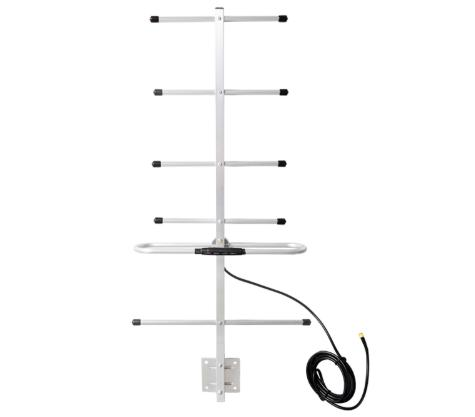
Point-to-Point Backhaul places its own demands on the antenna: the link budget, the interference environment and the physical install all differ from a generic stacking yagi antennas deployment. This page works through those requirements and maps them onto specific models.
What the application demands
A point-to-point link is the one case where maximum gain is straightforwardly correct: both ends are fixed, both can be aimed, and the narrow beam that would be a liability elsewhere is exactly what raises the margin.
Turning that into a specification
- Take the operating band from the radio datasheet, including any guard at the band edges.
- Decide the coverage shape first, omnidirectional or sector, and only then take the highest gain that still fits it.
- Measure the feedline run and subtract its loss before comparing antenna gain figures.
- Confirm the connector on the radio and order the matching interface rather than adapting in the field.
- Check Fresnel-zone clearance over the whole path, not just line of sight at the endpoints.
Models used for Point-to-Point Backhaul
| Model | Band (MHz) | Gain | Polarization | Length | Connector |
|---|---|---|---|---|---|
| AW-YG0890-18 | 824–960 | 18 dBi | Vertical | 1290 mm | N-Female |
| AW-YG0450-12 | 450–470 | 12 dBi | Vertical | 870 mm | N-Female |
| AW-YG0890-12 | 824–960 | 12 dBi | Vertical | 465 mm | N-Female |
| AW-YG2400-18 | 2400–2483 | 18 dBi | Vertical | 580 mm | N-Female |
| AW-YG1922-16 | 1720–2170 | 16 dBi | Vertical | 610 mm | N-Female |
| AW-YG0433-12 | 428–438 | 12 dBi | Vertical | 920 mm | N-Female |
| AW-LP4386-13 | 430–860 | 13 dBi | Vertical | 1450 mm | N-Female |
| AW-WM0912-9 | 902–928 | 9 dBi | Vertical | 210 mm | N-Female |
| AW-WM5158-23 | 5725–5850 | 23 dBi | Vertical | 305 mm | N-Female |
| AW-PA5158-V18B65 | 5100–5850 | 18 dBi | Vertical | 580 mm | N-Female |
| AW-WM2400-18 | 2400–2483 | 18 dBi | Vertical | 305 mm | N-Female |
| AW-PA5158-V15B65 | 5100–5850 | 15 dBi | Vertical | 260 mm | N-Female |
Grounding and surge protection
A stacked array presents more metal at height; bond the support structure and install a surge arrestor on the combined feed.