
Dual-Band GNSS L1/L5 Stacked Patch Antenna Fits in 20x20mm Package
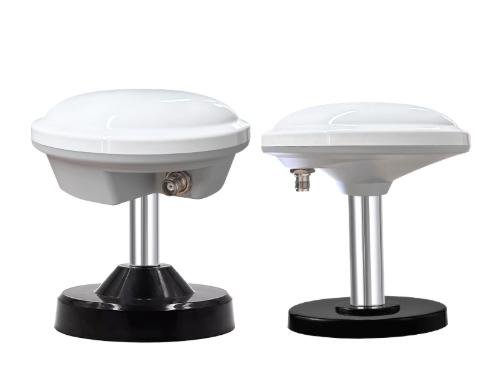
A compact global navigation satellite system (GNSS) antenna supporting both L1 and L5 frequency bands has been detailed by Electronics Weekly, featuring active and passive modes within a 20×20×8mm package.
Dual-Band GNSS Technology
The antenna receives signals on two distinct frequency bands: L1 at 1575.42 MHz and L5 at 1176.45 MHz. Operating on both frequencies allows the receiver to correct for ionospheric errors, significantly improving positioning accuracy compared to single-band solutions.
L5 is a modern signal designed for safety-critical applications, offering higher power and better resistance to interference. Combining it with the widely-used L1 band provides robust performance in challenging environments, such as urban canyons or under foliage. Multi-constellation support across GPS, Galileo, and BeiDou further enhances reliability.
Design and Integration
Measuring just 20×20×8mm, the stacked patch configuration keeps the footprint small while maintaining excellent antenna performance. The compact size makes it suitable for portable devices, drones, and wearable technology where board space is extremely limited.
The antenna’s dual-feed design supports right-hand circular polarization, essential for reliable satellite signal reception. Its construction balances gain, bandwidth, and physical dimensions to meet the needs of modern multi-constellation GNSS receivers. Typical patch materials like ceramic help achieve stable temperature performance.
Active and Passive Modes
An internal low-noise amplifier (LNA) can be enabled to boost weak signals in passive mode, or bypassed when an external LNA is used. This flexibility allows system designers to tailor the antenna’s operation to specific requirements, optimizing power consumption and noise figure.
Selectable active/passive modes also help manage power budgets in battery-powered applications. By disabling the internal amplifier, devices can conserve energy when signal strength is adequate or when using an active antenna module. This adaptability suits both high-performance and power-sensitive designs.
Applications and Benefits
Such antennas are ideal for applications requiring high precision in a small form factor, including autonomous vehicles, precision agriculture, and surveying equipment. The dual-band capability enhances accuracy to submeter levels, a critical requirement for these industries.
With the growing adoption of L5 by global constellations, this antenna design aligns with the trend toward more reliable and interference-resistant navigation. Its versatility supports both existing and next-generation GNSS solutions. The stacked patch approach ensures consistent performance without increasing device size.
The dual-band L1/L5 stacked patch antenna, reported by Electronics Weekly, combines active and passive modes in a 20×20×8mm package for high-accuracy GNSS applications.
Why This Matters
The introduction of a compact active/passive dual-band stacked patch antenna addresses the growing demand for high-precision location services in small devices. By supporting both L1 and L5, it enables better accuracy and interference resilience, crucial for emerging applications like autonomous navigation and IoT tracking. Its tiny footprint can accelerate integration into consumer and industrial products.
FAQ
Why is GNSS L5 important?
The L5 signal band was introduced to provide higher power and improved resistance to interference, making it ideal for safety-critical applications such as aviation and autonomous vehicles. Combining L5 with L1 allows receivers to compensate for ionospheric delay, achieving much greater accuracy than L1-only systems.
How does an active GNSS antenna differ from a passive one?
An active GNSS antenna includes a built-in low-noise amplifier to boost weak satellite signals before they travel down the cable, reducing signal loss. A passive antenna has no amplification and relies solely on the receiver's sensitivity, often used when cable runs are short or external amplification is already present.
What is a stacked patch antenna?
A stacked patch antenna uses two or more radiating elements layered above each other to cover multiple frequency bands within a single compact footprint. This design provides dual-band performance without increasing the antenna's width or length, suitable for size-constrained devices.
What are typical applications for a 20x20mm GNSS antenna?
Applications include drones, wearable trackers, handheld surveying devices, and automotive telematics systems. The small size and dual-band capability make it well-suited for any product needing precise location data where space and power are limited.
Sources
Source: "RF antenna" – Google News