
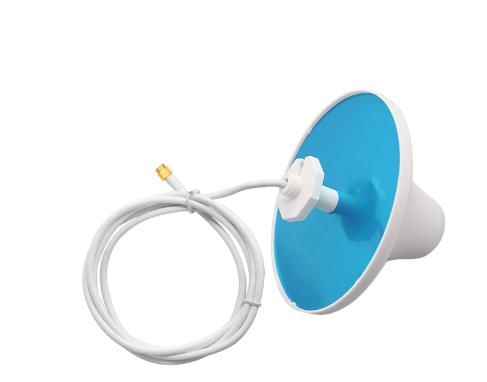
In-Building Coverage places its own demands on the antenna: the link budget, the interference environment and the physical install all differ from a generic mining and tunnel coverage antennas deployment. This page works through those requirements and maps them onto specific models.
What the application demands
Building interiors punish every dB. Concrete, low-emissivity glass and metal stud walls each take a substantial bite, so the antenna needs to be inside the space it serves rather than shooting at it through a wall.
Turning that into a specification
- Take the operating band from the radio datasheet, including any guard at the band edges.
- Decide the coverage shape first, omnidirectional or sector, and only then take the highest gain that still fits it.
- Measure the feedline run and subtract its loss before comparing antenna gain figures.
- Confirm the connector on the radio and order the matching interface rather than adapting in the field.
Models used for In-Building Coverage
| Model | Band (MHz) | Gain | Polarization | Length | Connector |
|---|---|---|---|---|---|
| AW-ID0827-11 | 698–2700 | 11 dBi | Vertical | 295 mm | N-Female |
| AW-ID0827-9 | 698–2700 | 9 dBi | Vertical | 295 mm | N-Female |
| AW-ID0827-5 | 806–2700 | 5 dBi | Vertical | 185 mm | N-Female |
| AW-ID0827-3 | 806–2700 | 3 dBi | Vertical | 185 mm | N-Female |
| AW-CBK0827-4 | 698–2700 | 4 dBi | Vertical | 190 mm | N-Male |
| AW-DT0827-3 | 698–2700 | 3 dBi | Vertical | 230 mm | SMA-Male |
| AW-CBK3538-5 | 3300–3800 | 5 dBi | Vertical | 160 mm | N-Male |
Grounding and surge protection
Surface head-frame antennas need conventional lightning protection; underground antennas are shielded by the rock mass.