
Phased-Array Antennas: How mmWave 5G Works in Smartphones
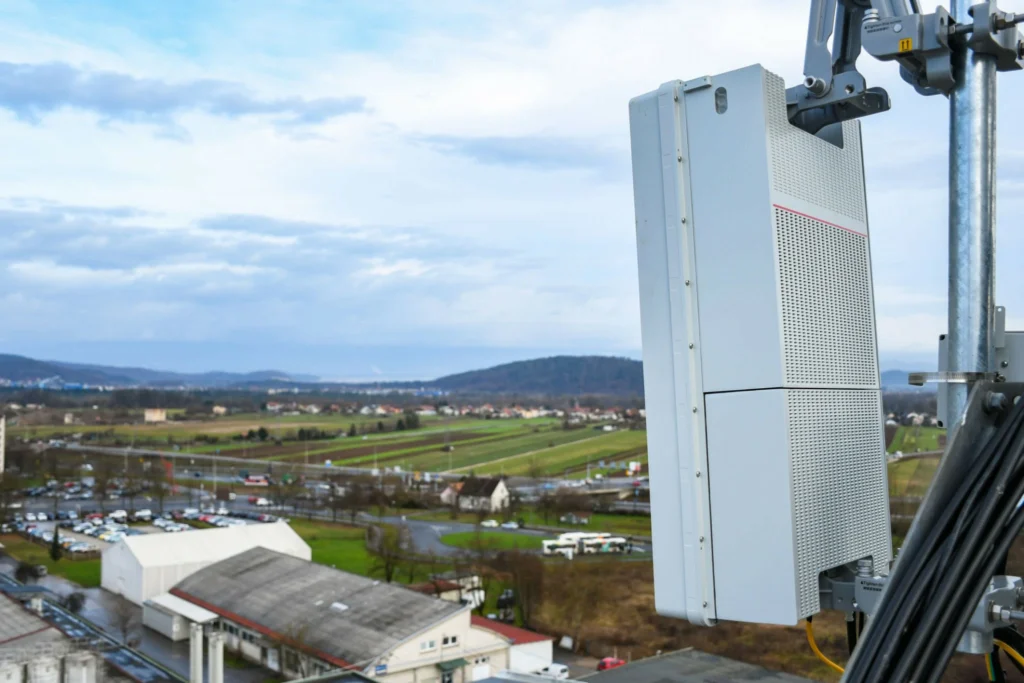
Apple’s latest iPhone 17 Pro integrates a narrow, radio-transparent strip along its top edge to house the mmWave 5G antenna array. This component, capable of handling frequencies above 24 GHz, is central to achieving multi-gigabit wireless speeds on a handheld device. Such a design choice underscores the complex antenna engineering required to make high-band 5G practical in everyday use.
The Physics of Millimeter Waves
Millimeter-wave signals occupy spectrum between 24 GHz and 100 GHz, offering vast bandwidth but extremely short wavelengths. At these frequencies, radio waves behave more like light, traveling primarily by line of sight and suffering severe attenuation from obstacles like walls, foliage, or even a user’s hand. Skin depth in conductive materials is shallow, meaning metal surfaces reflect almost all energy, making standard smartphone housings formidable barriers.
To overcome these losses, phones must incorporate antenna windows made from materials transparent to radio frequencies, such as engineered plastics or ceramics. The top-edge placement on the iPhone 17 Pro minimizes the chance of signal blockage during typical two-handed use, helping maintain a stable connection to nearby small cells. Without such careful design, mmWave coverage would be unreliable indoors or in crowded spaces.
How Phased-Array Antennas Work
Unlike traditional omnidirectional antennas, the mmWave module in a smartphone uses a phased array—multiple small antenna elements fed with phase-shifted signals. By electronically controlling the phase of each element, the array can steer a focused beam toward the nearest base station without any moving parts. This beamforming capability is essential for maintaining a link as the device moves or rotates.
Modern arrays integrate antennas, power amplifiers, and beamforming circuitry into a single compact module. The iPhone’s module likely contains a grid of patch antennas on a multilayer substrate, with active components switched at nanosecond timescales. Rapid beam switching allows the phone to track multiple signal paths, using reflections to work around partial obstructions and improve reliability in challenging environments.
Integration Challenges in Smartphones
Fitting a phased-array system into a slim, metal-framed phone demands creative engineering. Designers must position multiple antenna modules around the device, often cooperating with sub-6 GHz and Wi-Fi radios, while preventing interference. Thermal management becomes critical, as power-hungry mmWave transceivers can generate heat quickly during sustained high-throughput sessions.
Material selection for the antenna window involves balancing radio transparency, structural integrity, and water resistance. The iPhone 17 Pro’s top strip is likely made of a glass-ceramic composite that matches the phone’s aesthetic while passing high-frequency signals with minimal loss. Such integration efforts reflect the industry-wide push to make 5G invisible to users, functioning seamlessly even as hardware complexities mount.
The Future of mmWave User Experiences
Current mmWave deployments are concentrated in dense urban areas, stadiums, and airports, where small cells provide the necessary density. Smartphone makers like Apple continue to refine antenna design to support broader adoption, from augmented reality headsets to real-time cloud collaboration. Improved beam management and multi-panel arrays could one day make mmWave as reliable as 4G, even in moderate mobility scenarios.
As carriers expand their mmWave footprint, antenna placement will remain a key differentiator among premium devices. The top-mounted strip on the iPhone 17 Pro may become a template for future flagship designs, influencing how engineers balance form and function. Yet, one open question lingers: will advanced metamaterials eventually allow entire phone enclosures to become transparent to mmWave signals, making dedicated antenna windows obsolete, or will the physics of high frequencies demand ever more specialized solutions?
Why This Matters
The strategic placement of mmWave antenna windows is a direct response to signal propagation challenges, with implications for device industrial design and user experience. As 5G networks mature, such engineering choices will influence not only smartphone aesthetics but also the feasibility of emerging applications like mobile AR and wireless VR, ultimately shaping consumer expectations for speed and reliability.
FAQ
Why does mmWave 5G need special antennas?
Millimeter-wave signals have very short wavelengths and high susceptibility to blockage. Standard metal phone bodies block them, so a radio-transparent window is necessary. Phased-array antennas are used to electronically steer and focus the signal, compensating for movement and obstructions.
How does beamforming improve mmWave connectivity?
Beamforming uses multiple antenna elements to create a directional signal beam toward a cell tower. By adjusting the phase of each element, the beam can be steered rapidly without moving parts, maintaining a strong link as the user moves or rotates the phone. This is crucial for mmWave, where signals don't diffract around obstacles well.
Why is the mmWave antenna placed on the top edge?
Top placement reduces the risk of the user's hand or fingers blocking the signal when holding the phone. Because mmWave signals are easily attenuated, placing the antenna where it is least likely to be covered during normal use helps ensure consistent performance.
Will all future smartphones have visible antenna windows?
Not necessarily. Materials science is advancing, with research into RF-transparent metals and conformal antennas. However, mmWave's line-of-sight nature means careful antenna placement will remain critical, so some form of window or non-conductive area is likely for the foreseeable future.
Sources
Related news: iPhone 17 Pro’s Top Strip Identified as 5G Antenna Window