
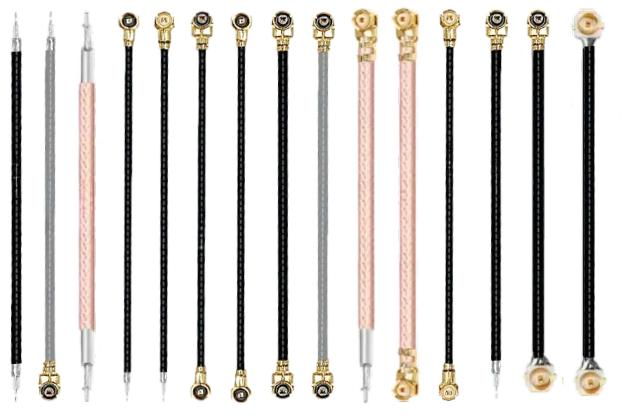
The questions that come up most often in rf coaxial cables and assemblies antennas enquiries, answered with the numbers rather than with generalities.
What gain do I actually need for rf coaxial cables and assemblies antennas?
The catalog spans 2 to 35 dBi. For general area coverage 5 to 9 dBi is usually right; above that the elevation pattern narrows enough that anything close to the mast falls into the null underneath it. For a fixed point-to-point link take the highest gain the mount can hold steady, because there the narrow beam is the point.
Does a higher-gain antenna increase transmit power?
No. Gain is passive; it redistributes the power the radio already produces, concentrating it in one direction at the expense of every other direction. The regulatory limit is on effective radiated power, so swapping in a higher-gain antenna can put a legally compliant radio over the limit without changing anything in the radio itself.
Can one antenna cover several bands?
Wideband models exist and are genuinely useful when the alternative is two masts and two feedlines, but they pay for the coverage in efficiency and in pattern consistency across the range. Where a single band carries the traffic that matters, a band-specific antenna will outperform a wideband part on that band every time.
Which connector do these ship with?
Standard builds use an N-Female interface. Other interfaces are available as a factory build; a field-fitted adapter also works but adds an extra mismatch and one more joint to fail, which on an outdoor mast is the joint that eventually lets water in.
How much does the feedline cost me?
More than most people budget for. At 2.4 GHz a 10 m run of RG58 is roughly 6 dB, which is larger than the difference between most of the models on this page. Compare a shorter run or a lower-loss cable against a higher-gain antenna before spending on the antenna.
Is a surge arrestor necessary?
The coax run is where the surge arrestor is installed, typically at the building entry, bonded to the single-point ground.
Shortlist

AW-PA1722-V18B65
- Band: 1.7-2.2 GHz
- Gain: 18 dBi
- Connector: N-Female
AW-PA7090-V18B65
- Band: 698-960 MHz
- Gain: 18 dBi
- Connector: N-Female
AW-PA8090-V18B65
- Band: 806-960 MHz
- Gain: 18 dBi
- Connector: N-Female
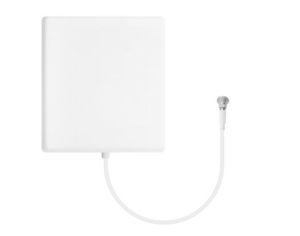
AW-PA1722-V15B65
- Band: 1.7-2.2 GHz
- Gain: 15 dBi
- Connector: N-Female