
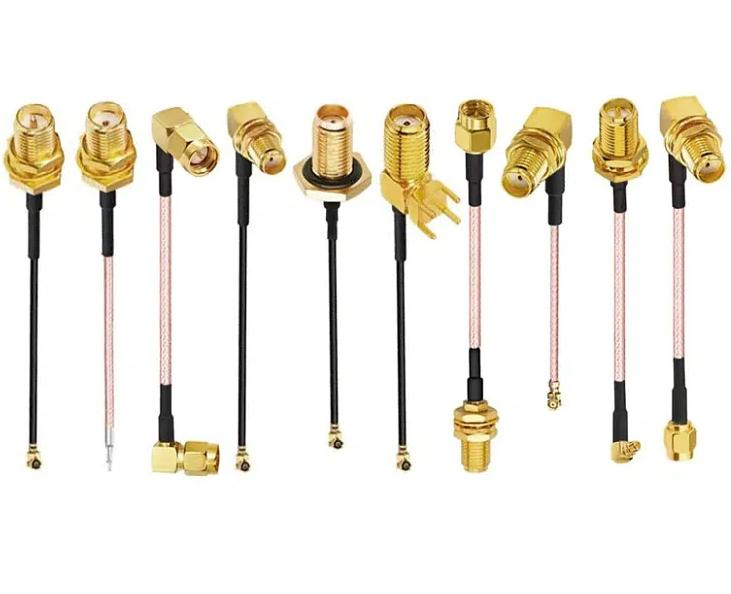
Key Takeaways
- SMA and RP-SMA connectors are not interchangeable due to reversed center contacts, despite identical thread direction and physical size.
- RP-SMA dominates Wi-Fi and IoT gear as a legacy of FCC regulations aimed at discouraging unauthorized antenna changes.
- Standard SMA is widely used in cellular, GPS, and test equipment for its durability and high-frequency performance.
- Always inspect the center pin or hole and thread rotation to identify connector type before mating—forcing a mismatch can damage equipment.
- When integrating mixed systems, use proper adapters sparingly to minimize insertion loss and maintain link budget.
Nothing derails a wireless installation faster than discovering your antenna and device won’t connect because of an incompatible connector. If you’ve ever stared at a threaded metal cylinder and wondered whether it’s SMA or RP-SMA, you’re not alone. This guide clarifies the essential differences between these two common RF connector types, how to quickly identify each one, and the mating rules that will keep your signal path intact.
The Physical Difference: Pin vs. Socket Configuration
The core distinction between SMA and RP-SMA connectors lies not in the threaded metal body—which is identical—but in the center contact arrangement. In a standard SMA antenna connector, the plug (the side with external threads) carries a prominent center pin, while the jack (internal threads) houses a matching recessed socket. This follows traditional coaxial logic: the male contact inserts into the female contact.
When you look at an RP-SMA antenna connector, that logic is inverted. The acronym stands for Reverse Polarity, meaning the center contact polarity is reversed relative to the connector gender. The plug side still has external threads, but its center is a hollow socket. Conversely, the jack side has internal threads but a center pin. The threaded interface remains the same, so the two types can be physically screwed together—but doing so results in a broken or severely attenuated RF connection, often with no obvious visual warning.
Gender Confusion: Threads, Not Pins, Define Male and Female
One of the most common ordering mistakes stems from assuming that the center pin indicates a male connector. In RF engineering, gender is determined solely by the threads: male connectors (plugs) have external threads, female connectors (jacks) have internal threads. This rule holds regardless of the center contact type, which is why an RP-SMA male connector—with external threads—features a socket rather than a pin.
This can lead to costly errors when procurement teams or technicians rely on catalog shorthand. A request for an “SMA male cable” typically yields a connector with a pin, while “RP-SMA male” brings a connector with a socket. However, ambiguous labeling still appears in some supplier listings. A practical safeguard is to always verify product photos or detailed specifications, looking specifically at the center contact. Specifying “RP-SMA plug” (or “jack”) and confirming the center hole/pin configuration in writing can eliminate guesswork and prevent mismatches during deployment.
Visual Identification and Typical Use Cases
A quick visual check can save minutes of trial and error:
- External threads + center pin = SMA male
- Internal threads + center socket = SMA female
- External threads + center socket = RP-SMA male
- Internal threads + center pin = RP-SMA female
This simple rule holds for most cable connectors, bulkhead adapters, and antenna terminals. If you’re holding an antenna with a protruding pin and a threaded barrel that rotates freely, you’re likely looking at an RP-SMA female; if the pin is instead a hole, it’s SMA female.
Standard SMA is widely used in cellular modems, GPS modules, and professional test equipment, where robust, repeatable connections are critical. RP-SMA dominates consumer Wi-Fi access points, routers, and many IoT devices. The proliferation of RP-SMA in Wi-Fi gear is partly a historical byproduct of FCC regulations that sought to discourage end users from easily swapping antennas, thereby limiting unauthorized signal enhancement. Knowing which your equipment uses—before you order cables or antennas—avoids project delays and potential equipment damage.
Practical Considerations for SMA and RP-SMA Deployment
Selecting the right connector goes beyond identifying the polarity. In real-world B2B wireless setups—from cellular routers in metal enclosures to outdoor Wi‑Fi access points—the mechanical and electrical environment dictates which variant performs best. For instance, standard SMA connectors are prevalent in 4G/5G cellular modems and GPS modules because these systems often require higher mating-cycle durability and precise impedance matching up to several gigahertz. An SMA RF connector found in professional test equipment may tolerate up to 12.4 GHz when precision-machined, but a typical commercial‑grade SMA should still handle 6 GHz with low return loss.
RP‑SMA, while electrically identical in its RF path, is dominant in consumer and industrial Wi‑Fi (2.4/5 GHz) due to historical FCC regulations that discouraged end‑users from swapping antennas. This legacy persists in IoT gateways and many unlicensed-band radios. However, the choice is not just about frequency—physical mounting matters. Bulkhead versions of both SMA and RP‑SMA allow cables to pass through enclosure walls, and are available with various sealing methods. For outdoor or marine installations, look for connectors with IP67 or better ratings, or add self‑amalgamating tape to the interface after mating to prevent moisture ingress.
When integrating into an existing system, always audit your bill of materials. Mixing SMA and RP‑SMA without adapters can halt commissioning. Pigtail cables that transition from U.FL or MMCX to an SMA or RP‑SMA bulkhead are common in embedded designs; specifying the wrong polarity here will lead to a dead link. Fortunately, adapter cables and barrel converters exist to reconcile mismatched equipment, but each inline component introduces 0.2–0.5 dB insertion loss, so avoid chaining multiple adapters in critical links.
Finally, consider mechanical stress. Larger antennas—such as omnidirectional fiberglass whips or panel arrays—exert significant leverage on the connector. A robust flange‑mount or panel‑seat connector distributes that load better than a simple PCB‑edge SMA. If your enclosure vibrates (e.g., in‑vehicle or on machinery), select connectors with good retention force and consider a thread‑locking compound for both standard and reverse‑polarity interfaces.
| Aspect | Standard SMA | RP‑SMA |
|---|---|---|
| Center contact (male) | Pin | Hole |
| Center contact (female) | Hole | Pin |
| Threads (male) | Internal, rotating nut | Internal, rotating nut |
| Threads (female) | External, fixed barrel | External, fixed barrel |
| Typical max frequency | Up to 12.4 GHz (precision) | Same mechanical interface; often rated to 6‑7 GHz in consumer gear |
| Primary markets | Cellular, GPS, test equipment, military | Wi‑Fi (2.4/5 GHz), IoT, consumer routers |
| Interchangeability | Not directly interchangeable—requires adapter with correct center‑contact crossover | |
Making the Right Choice for Your RF Setup
The decision between SMA and RP‑SMA ultimately comes down to the equipment you already own or plan to purchase. If your cellular modem or GPS receiver has a female SMA jack, you need a male SMA antenna—no exceptions. Conversely, if your Wi‑Fi access point has a male RP‑SMA connector, your antenna or cable must terminate in a female RP‑SMA. Before ordering, physically inspect the connectors: look for the center pin or hole, and note whether the threaded barrel rotates freely. Keep a visual guide handy until you build confidence.
A common pitfall is assuming that “reverse polarity” means the threads are reversed—they are not. The thread direction is standard right‑hand for both. Only the center contact arrangement is swapped. Always double‑check, especially when mixing purchased antennas with custom‑built cable assemblies. When in doubt, select a connector type from a reputable manufacturer and use a continuity tester to verify the pin‑to‑pin path.
Finally, plan for the whole signal chain. A well‑matched SMA or RP‑SMA interface preserves the antenna’s gain and pattern integrity; a mismatched connector can cause reflections that reduce throughput and range. If your project will be deployed in the field, consider stocking a small set of verified adapters and a torque wrench to avoid over‑tightening, which can distort the center contact. With a clear understanding of polarity, mechanics, and application context, you’ll avoid costly downtime and ensure reliable wireless communication.
Frequently Asked Questions
What happens if I accidentally mate an SMA male with an RP-SMA female?
They may thread together mechanically, but the center contacts won't connect properly because the pin and socket are reversed. This results in an open circuit or severe signal loss. Forcing the connection can also bend or break the center pin, permanently damaging the connector.
Why did the FCC mandate RP-SMA for Wi-Fi devices?
The FCC required RP-SMA to prevent consumers from easily attaching higher-gain antennas, which could cause the device to exceed its authorized transmit power limits. By reversing the center contact, standard aftermarket antennas became incompatible without an adapter, discouraging unauthorized modifications that increase interference.
Can I use a simple adapter to convert between SMA and RP-SMA?
Yes, adapter cables or barrel adapters are available that properly cross-connect the center pins. However, each adapter introduces a small insertion loss (typically 0.2–0.5 dB), so it’s best to use them sparingly and factor the loss into your link budget, especially for long cable runs or marginal signal conditions.
What is the typical frequency limit for SMA and RP-SMA connectors?
Both share the same mechanical interface and can operate well into the microwave range. Precision SMA connectors are often rated to 12.4 GHz or higher, while generic commercial versions may be limited to 6 GHz. Always check the manufacturer’s data sheet for the exact frequency rating of your specific connector model.
How do I identify RP-SMA on a device without disassembling it?
Look at the connector’s center: an RP-SMA male has a socket (hole) inside the threaded barrel, while an RP-SMA female has a pin inside a threaded nut. If the outer barrel rotates freely, it’s the female (nut-side); if it’s fixed, it’s the male (jack-side). Compare visually with known standard SMA connectors if you’re unsure.