
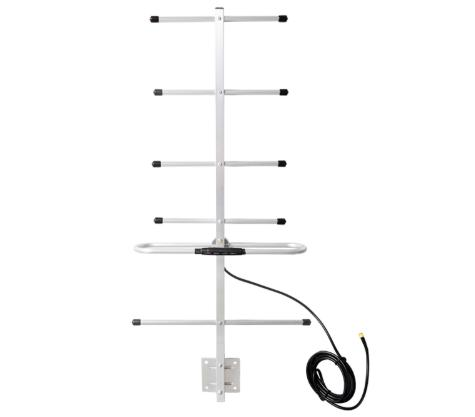
High front-to-back ratio directional antennas for long-range point-to-point links and fixed CPE. This page covers how the class behaves specifically in how to select an antenna work, and lists the 6 catalog models that fit.
What this class does well
A Yagi gives the best gain per unit of cost and weight of any common directional antenna, and its high front-to-back ratio makes it useful specifically where interference arrives from behind the link. On a fixed path it is hard to beat.
Where it falls down
Narrow bandwidth and a narrow beam. An LPDA covers far more spectrum, and on any mount that moves in wind the narrow beam turns into a fading link.
The range we stock
Across the 6 models in this class the gain runs from 12 to 18 dBi, frequency coverage from 428 to 2483 MHz, and the longest dimension from 465 mm to 1290 mm. Check the size figure early. It decides the mount, and on a shared mast it decides whether the part fits at all.
Yagi-Uda Antenna models
| Model | Band (MHz) | Gain | Polarization | Length | Connector |
|---|---|---|---|---|---|
| AW-YG0890-18 | 824–960 | 18 dBi | Vertical | 1290 mm | N-Female |
| AW-YG2400-18 | 2400–2483 | 18 dBi | Vertical | 580 mm | N-Female |
| AW-YG1922-16 | 1720–2170 | 16 dBi | Vertical | 610 mm | N-Female |
| AW-YG0890-12 | 824–960 | 12 dBi | Vertical | 465 mm | N-Female |
| AW-YG0433-12 | 428–438 | 12 dBi | Vertical | 920 mm | N-Female |
| AW-YG0450-12 | 450–470 | 12 dBi | Vertical | 870 mm | N-Female |
Specifying one for how to select an antenna
Mounting environment frequently decides the antenna class before any electrical parameter: a pole gets an omnidirectional or sector antenna, a wall gets a panel, a vehicle gets a magnetic-base or low-profile antenna. Confirm the connector before ordering: changing the interface later means either an adapter, which adds a mismatch and a failure point, or a re-terminated cable. Standard builds ship with an N-Female interface.