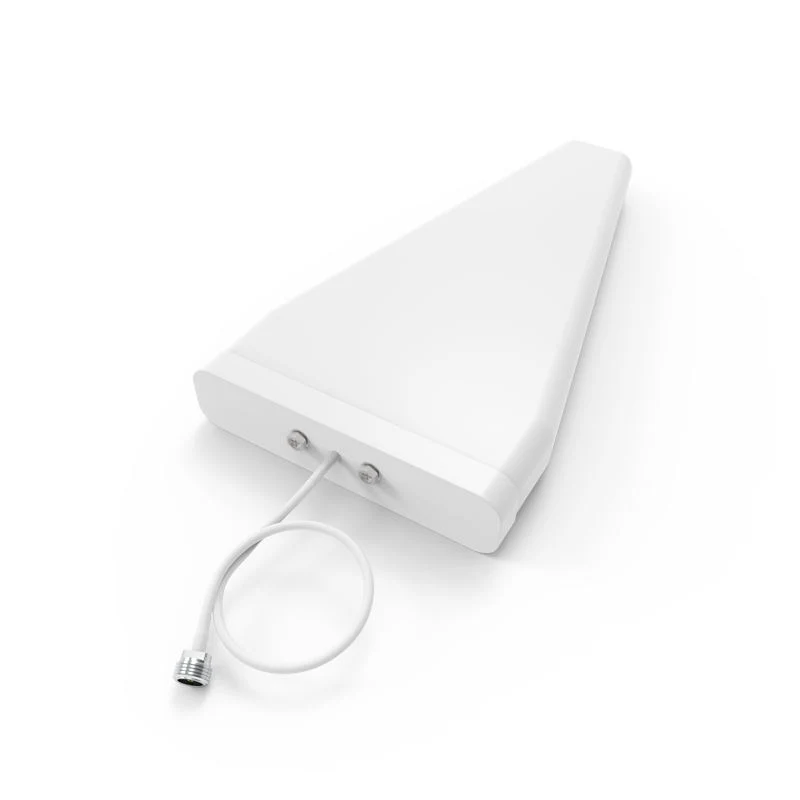
| Model | LP-300-1500 |
|---|
| Frequency (manufacturer model field) | 300-1500MHz |
|---|
| Bandwidth (manufacturer model field) | 300-1500MHz |
|---|
| Gain (manufacturer model field) | 9 dBi. |
|---|
| Frequency Range | 300-1500 MHz |
|---|
| Gain | 9 dBi. |
|---|
| Bandwidth | Entire Band |
|---|
| Polarization | Vertical or Horizontal |
|---|
| Input Impedance | 50 Ohms. |
|---|
| Radiation Pattern | Directional |
|---|
| Horizontal Beamwidth -Half Power Points | 65 Degrees |
|---|
| Front to Back Ratio | 18 dB. |
|---|
| VSWR - Equal To or Better Then | 1:2 |
|---|
| RF Power Handling Capacity | 250 Watts. |
|---|
| Input Termination | N-Female |
|---|
| Lightning Protection | Direct Ground |
|---|
| Antenna Materials | All Aluminum |
|---|
| Mounting Hardware -Materials | Stainless Steel |
|---|
| Wind Rating | 200 Km/Hr. |
|---|
| Overall Length | 0.8 Meter |
|---|
| Shipping Length | 0.9 Meters. |
|---|
| Support Boom -Material - O.D. | AluminumSquare Tube |
|---|
| Elements - Materials- Cross Section - Outer Diameter | AluminumRound Tube |
|---|
| Maximum Mount Pipe Diameter | 52 mm (2 Inches) |
|---|
| Gross Weight | 4 Kgs. |
|---|
| Operating Temperature | (-) 30 to +70 Degrees Celsius |
|---|
| Storage Temperature | (-) 40 to +80 Degrees Celsius |
|---|
| Humidity | 0 to 95% RH |
|---|
| Unified 300–1500 MHz Coverage | Seamlessly transitions from the primary UHF tactical bands through to the L-band microwave spectrum. This allows a single aperture to manage diverse signals, including public safety, military LMR, and GPS/GNSS downlinks. |
|---|
| Directional 9 dBi Gain | By focusing RF energy into a defined 65-degree horizontal beam, the antenna provides superior standoff range. The 17 dB Front-to-Back ratio ensures high rear-lobe suppression, protecting friendly systems and maintaining signal secrecy. |
|---|
| High-Power 250W Throughput | Built for continuous-duty operations, this antenna manages up to 250 Watts of RF power, making it a formidable platform for Electronic Attack (EA) and signal saturation missions. |
|---|
| Polarization Agility | The mounting bracket is strategically welded at the back end of the dual booms, allowing for fast field-rotation between Vertical and Horizontal polarization to match the target signal. |
|---|
| Aerospace-Grade Materials | Constructed from 6063T6 architectural anodized aluminum alloy with square-tube booms and round-rod elements. All screws, nuts, and bolts are made of marine-grade stainless steel to prevent oxidation in coastal environments. |
|---|
| Weatherproof Signal Integrity | The internal coaxial cable is sealed inside the support boom, providing an environmental shield for the signal path. The entire assembly is powder-coated for maximum resistance to UV radiation, salt fog, and acid rain. |
|---|
| D.C. Grounded Safety | The antenna operates at D.C. ground, providing a low-resistance discharge path for lightning protection and bleeding off static noise for high-fidelity spectrum monitoring. |
|---|
| Rear-End Mounting | The mounting clamps are positioned at the back end of the antenna, allowing for clear "bore-sight" aiming without the mounting pole interfering with the radiation pattern. |
|---|
| Consistent 9 dBi Gain | Maintains linear gain and predictable radiation patterns across the entire 1.2 GHz bandwidth. |
|---|
| No Loading Techniques | Uses full-sized elements to ensure maximum electrical efficiency and structural integrity. |
|---|
| Rapid Tactical Setup | Supplied in a fully assembled condition, allowing for immediate field deployment. |
|---|
| Universal Mounting | Compatible with standard 51 mm (2-inch) diameter mast pipes. |
|---|
| Published detail | In Electronic Warfare, the LP-300-1500 acts as a Directional Force Multiplier. Its 9 dBi gain allows an operator to concentrate jamming energy toward a specific threat vector rather than wasting power in 360 degrees. |
|---|
| Surgical Jamming & Denial | With a 65-degree horizontal beamwidth, this antenna can "flood" a specific enemy communication node or a known UAV telemetry uplink with 250 Watts of concentrated RF. This is highly effective for disrupting localized command-and-control (C2) without interfering with friendly systems located behind the antenna. |
|---|
| High Front-to-Back Ratio (17 dB) | This specification is vital for EW operators. It ensures that while the front of the antenna is neutralizing a target, the "back-lobe" energy is suppressed by 17 dB, protecting the operator's own sensitive receivers and electronics from self-interference. |
|---|
| Polarization Matching | The ability to switch between Horizontal and Vertical polarization in the field is a decisive EW advantage. If an adversary shifts their antenna orientation to evade jamming, the LP-300-1500 can be rotated to re-establish maximum coupling and denial efficiency. |
|---|
| Published detail | For SIGINT teams, the LP-300-1500 is a Direction-Finding (DF) and Exploitation tool. Its linear gain across the 1.2 GHz bandwidth is essential for accurate signal analysis. |
|---|
| Line-of-Bearing (LOB) Acquisition | Because of its directional properties, the LP-300-1500 is used to "hunt" signals. By rotating the antenna until the Signal Strength (RSSI) peaks, operators can establish a precise Line-of-Bearing toward a transmitter of interest. |
|---|
| Flat Gain Response | Unlike many antennas that have gain "peaks and valleys" over a wide range, the LP-300-1500 maintains a consistent 9 dBi gain. This allows SIGINT software to accurately calculate the Effective Radiated Power (ERP) of a target transmitter, which is a key step in identifying the type of hardware being used by an adversary. |
|---|
| Ultra-Low Noise Floor | The 6063T6 aluminum construction and D.C. grounded design minimize Passive Inter-Modulation (PIM). This ensures that when searching for weak, low-probability-of-intercept (LPI) signals, the antenna does not introduce "ghost signals" or internal noise that could lead to false positives. |
|---|
| UHF/L-Band Mastery | A single LP-300-1500 can be used to monitor:UHF Tactical (300-500 MHz): Military LMR and satellite uplinks.Public Safety (700-900 MHz): P25, TETRA, and FirstNet bands.L-Band (1000-1500 MHz): GNSS/GPS downlinks, Iridium, and tactical data links. |
|---|
| UHF Tactical (300-500 MHz) | Military LMR and satellite uplinks. |
|---|
| Public Safety (700-900 MHz) | P25, TETRA, and FirstNet bands. |
|---|
| L-Band (1000-1500 MHz) | GNSS/GPS downlinks, Iridium, and tactical data links. |
|---|
| Ground-to-Air Surveillance | Its directional gain makes it superior for tracking aircraft or drones at a distance. Operators can "track" a flight path with high-gain precision, ensuring a stable link even at the extreme edge of the line-of-sight horizon. |
|---|
| Precipitation Static (P-Static) Immunity | The D.C. Grounded design is critical for monitoring in desert sandstorms or coastal rain. It bleeds off static electricity that would otherwise create "pops" and "crackles" in the received audio or data, ensuring high-fidelity signal recording. |
|---|
| Frequency stated in title | 300-1500 MHz |
|---|
| Gain stated in title | 9 dBi |
|---|
| Category | Horn, Dish, Grid & Log Periodic |
|---|