| Model | LP-800-2700 |
|---|
| Frequency (manufacturer model field) | 800-2700MHz |
|---|
| Bandwidth (manufacturer model field) | 800-2700MHz |
|---|
| Gain (manufacturer model field) | 9 dBi. |
|---|
| Frequency Range | 800 - 2700 MHz |
|---|
| Gain | 9 dBi. |
|---|
| Bandwidth | 800-2700MHz |
|---|
| Polarization | Vertical or Horizontal |
|---|
| Input Impedance | 50 Ohms |
|---|
| Radiation Pattern | Directional |
|---|
| Horizontal Beamwidth -Half Power Points | 60+/-5 Degrees Typical |
|---|
| Front to Back Ratio | 18+/-2 dB. |
|---|
| VSWR - Equal To or Better Then | Better Than 2.5:1 |
|---|
| Input Termination | N-Female |
|---|
| Lightning Protection | Direct Ground |
|---|
| Antenna Materials | 6063T6 Aluminum Alloy |
|---|
| Mounting Hardware -Materials | Marine Grade Stainless Steel |
|---|
| Wind Rating | 200 Km/Hr. |
|---|
| Overall Length | 440mm |
|---|
| Shipping Length | 460mm |
|---|
| Support Boom -Material - O.D. | AluminumSquare Tube |
|---|
| Elements - Materials- Cross Section - Outer Diameter | AluminumRound Rod |
|---|
| Mounting Clamps Position | At the back end of boom |
|---|
| Maximum Mount Pipe Diameter | 51mm |
|---|
| Gross Weight | < 3Kgs. |
|---|
| Operating Temperature | (-)30 to +70 Degrees Celsius |
|---|
| Storage Temperature | (-)40 to +80 Degrees Celsius |
|---|
| Humidity | 0 to 95% RH |
|---|
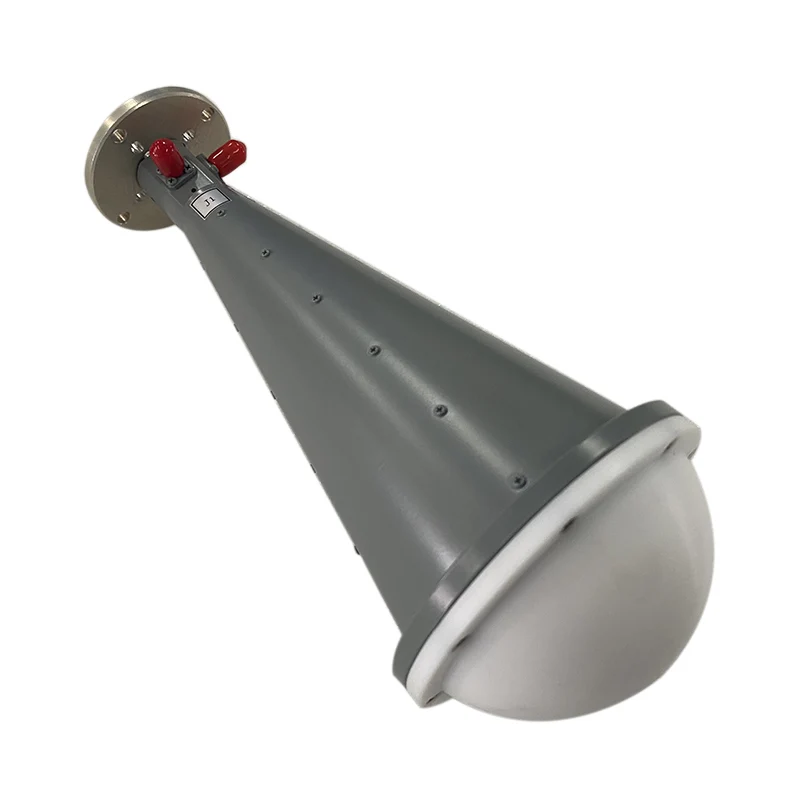
| Elite Fiberglass Radome Protection | The high-tech fiberglass enclosure is built for survivability. It offers exceptional RF transparency and structural strength, shielding the internal elements from corrosive saline air, acid rain, and ice formation while maintaining a low wind profile. |
|---|
| Full-Spectrum Unloaded Gain | By utilizing a full-sized, non-loaded element design, the antenna maintains a stable 9 dBi gain and high radiation efficiency across the entire 1900 MHz bandwidth, ensuring no signal loss at the frequency extremes. |
|---|
| Aero-Dynamic Tapered Design | The enclosure is specifically shaped for low wind loading (200 Km/Hr rating) and minimal ice accumulation, providing an aesthetically pleasing and tactical appearance for covert or high-profile installations. |
|---|
| PIM-Free Welded Architecture | Radiating elements are fully welded to the support booms to prevent RF inter-modulation and ensure mechanical stability under extreme vibration or shock (MIL-STD-810G). |
|---|
| Marine-Grade Hardware | All fasteners, including screws, nuts, and bolts, are made from high-grade stainless steel. The entire antenna is finished in Olive Green powder coating for superior corrosion resistance in coastal zones. |
|---|
| Direct D.C. Grounding | Operates at D.C. ground, providing a low-resistance path for lightning protection and suppressing atmospheric static for an ultra-quiet noise floor during sensitive monitoring missions. |
|---|
| Comprehensive 800–2700 MHz Coverage | GSM, CDMA, UMTS, LTE, Wi-Fi, and L/S-Band in one unit. |
|---|
| Rugged Fiberglass Radome | Elite protection against environmental degradation and mechanical shock. |
|---|
| High-Efficiency 9 dBi Gain | Superior directional focus across the entire wideband. |
|---|
| All-Welded 6063T6 Aluminum | Maximum durability and PIM-free performance. |
|---|
| MIL-STD-810G Certified | Tested for extreme temperature, shock, vibration, and salt fog. |
|---|
| Rear-End Mounting Plate | Fast installation on 51mm (2-inch) masts with optimized patterns. |
|---|
| Marine Grade Stainless Hardware | Total corrosion resistance for naval and coastal use. |
|---|
| Low Loss Coaxial Feed | Integrated cable with N-Female termination fixed at the mounting plate. |
|---|
| Published detail | The LP-800-2700 is a specialized tool for the modern, signal-dense urban battlefield. Covering 0.8 GHz to 2.7 GHz, it monitors the backbone of commercial communications and tactical data links. |
|---|
| Published detail | At frequencies between 0.8 GHz and 2.7 GHz, radio waves behave increasingly like light. They reflect sharply off glass, metal, and concrete. Each reflection can cause the signal's polarization to shift or rotate. |
|---|
| The "Drop-Out" Problem | A target's signal may bounce off several buildings before reaching your antenna. If your antenna is vertically fixed and the signal arrives rotated horizontally, you could experience a 20 dB signal loss. |
|---|
| The Strategic Scan | The 60-degree horizontal beamwidth of the LP-800-2700 acts as an RF "spotlight." By scanning the horizon, an operator can identify the strongest reflected path (Multipath Exploitation) rather than just pointing at the target's direct coordinates, ensuring a stable intercept even in "RF shadows." |
|---|
| Visual Deception | Without a radome, an adversary with binoculars can see the internal elements. They would immediately know if you are monitoring the low-band (800 MHz) or the high-band (2700 MHz) based on which elements are active. |
|---|
| Directional Obscuration | The tapered radome hides the exact "boresight" (pointing direction) of the antenna. This makes it impossible for an opponent to determine exactly which window, vehicle, or tower your team is currently targeting. |
|---|
| Power Density Focus | The 9 dBi gain acts as a "magnifying glass" for your RF energy. Instead of scattering 150W in all directions, the LP-800-2700 focuses that energy into a tight 60-degree cone. |
|---|
| Effective Radiated Power (ERP) | This concentration exponentially increases your ERP. By focusing the energy, you can successfully "drown out" a legitimate signal from several kilometers away, even when using relatively low input power. |
|---|
| Published detail | At frequencies approaching 3 GHz, sensitive SIGINT receivers are highly vulnerable to "Noise Floor" elevation, which can mask low-probability-of-intercept (LPI) signals. |
|---|
| Static Suppression | High-speed wind or dry air moving across the fiberglass radome creates "Precipitation Static" (P-Static). On an ungrounded antenna, this creates an electronic "hiss" that masks weak signals. |
|---|
| The Solution | The LP-800-2700 is D.C. Grounded. It constantly bleeds off this static charge to the mast and earth, ensuring the lowest possible noise floor for detecting "hidden" or low-power transmissions. |
|---|
| Microwave Cable Integrity | At 2700 MHz (2.7 GHz), cable loss is severe. Avoid standard RG-58. Use LMR-400 or LMR-600. Every 3 dB of cable loss effectively cuts your jamming power or reception sensitivity in half. |
|---|
| Boresight Alignment | Because the beamwidth is 60 degrees, a 30-degree error in alignment will drop your gain significantly. Use a compass to ensure the antenna is pointed exactly at the target sector for maximum intercept probability. |
|---|
| Connector Weather-Proofing | Microwave connectors are highly sensitive to moisture. A single drop of water in the N-type connector will cause a massive VSWR spike at 2.7 GHz. Use butyl rubber tape for a primary moisture seal on all outdoor connections. |
|---|
| Line-of-Sight (LOS) | At these frequencies, even thin plywood or heavy foliage can attenuate the signal by 10–15 dB. Always attempt to find an elevated position with a clear optical path to the target area. |
|---|
| Frequency stated in title | 800-2700 MHz |
|---|
| Gain stated in title | 9 dBi |
|---|
| Category | Horn, Dish, Grid & Log Periodic |
|---|