| Model | JC-66-88 |
|---|
| Frequency (manufacturer model field) | 66-88MHz |
|---|
| Bandwidth (manufacturer model field) | 66-88MHz |
|---|
| Gain (manufacturer model field) | 0 dBi |
|---|
| Frequency Range | 66-88 MHz |
|---|
| Gain | 0 dBi |
|---|
| Bandwidth | Entire Band |
|---|
| Polarization | Vertical |
|---|
| Input Impedance | 50 Ohms |
|---|
| Radiation Pattern | Omni-directional |
|---|
| VSWR - Equal To or Better Then | 3:1 |
|---|
| RF Power Handling Capacity | 150 Watts |
|---|
| Input Termination | N-Female |
|---|
| Antenna Materials | 6063T6 Aluminum & ABS |
|---|
| Mounting Hardware -Materials | Marine Grade Stainless Steel |
|---|
| Wind Rating | 200 Km/Hr. |
|---|
| Mounting Type | NATO 4 Holes or Customized |
|---|
| Overall Length | 1.7 Meters |
|---|
| Shipping Length | 1.8 Meters |
|---|
| Support Pipe O.D. | 50 mm |
|---|
| Radome Material | ABS or Fiber Glass |
|---|
| Radome Outer Diameter | 45 mm |
|---|
| Radome Length | 1.6 Meters |
|---|
| Radiating Elements - Material | High Quality Brass |
|---|
| Gross Weight | 2.5 Kgs. |
|---|
| Operating Temperature | (-)30 to +70 Degrees Celsius |
|---|
| Storage Temperature | (-)40 to +80 Degrees Celsius |
|---|
| Humidity | 0 to 95% RH |
|---|
| Hemispherical 78° Vertical Beam | At these lower frequencies, maintaining a wide vertical beam is essential for ground-to-ground and ground-to-air coverage. The 78-degree beamwidth ensures that the jamming signal remains effective even when the vehicle is traversing steep, uneven terrain. |
|---|
| Advanced Co-Axial Stub & Spark Gap Tech | These internal engineering techniques ensure a stable VSWR and consistent performance across the full 20 MHz bandwidth. This "plug-and-play" reliability is critical for rapid-response tactical scenarios. |
|---|
| NATO Mounting Standard | The integrated base uses the industry-standard NATO 4-hole pattern, allowing for immediate installation on vehicular side-mounts or adapter base plates. This ensures the antenna can be swapped or integrated into existing convoy sets with zero downtime. |
|---|
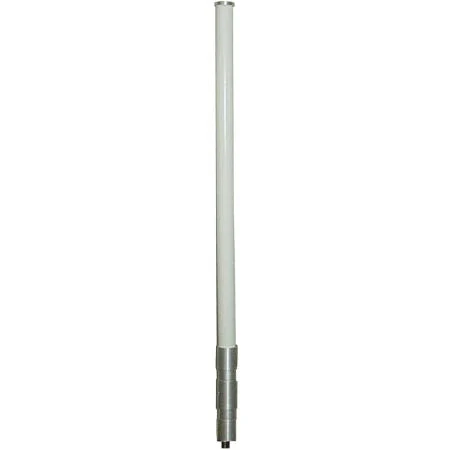
| Fiberglass Radome Protection | The large-diameter brass radiating elements are enclosed in a 44mm fiberglass housing. This radome is electrically transparent but mechanically robust, providing the strength needed to resist wind loads up to 170 Km/Hr and environmental debris. |
|---|
| Corrosion-Resistant Architecture | Utilizing high-class aluminum alloy and finished in tactical Olive Green, the antenna is shielded against UV radiation, salt spray, and ice formation. |
|---|
| Weather-Protected Feed | The N-Female termination is recessed at the bottom of the NATO mounting base. This keeps the critical RF connection shielded from moisture ingress and physical damage during high-speed transit. |
|---|
| Optimized 66–88 MHz Coverage | Targeted for low-band VHF tactical denial and monitoring. |
|---|
| Omni-Directional 0 dBi Gain | Creates a uniform "denial bubble" in all directions around the vehicle. |
|---|
| Wide 78° Vertical Beam | Ideal for rolling terrain and ground-to-air signal intercepts. |
|---|
| Brass Radiating Elements | High-quality in-phase feeding for maximum electrical stability. |
|---|
| Standard NATO Interface | Rapid integration for military and defense platforms. |
|---|
| Published detail | In the 66-88 MHz band, signals often follow the curvature of the earth (ground wave). |
|---|
| The Strategic Benefit | Because the vertical beam is 78 degrees wide, the JC-66-88 provides excellent coverage even when the antenna is tilted during vehicle maneuvers. This prevents "dead zones" that occur with high-gain antennas when the vehicle is not perfectly level. |
|---|
| Published detail | In the 66–88 MHz band, signals often follow the curvature of the earth (ground wave) or reflect off large geographic features. |
|---|
| The 78-Degree Advantage | Most tactical antennas in this frequency range are long whips that can "null out" or lose signal contact when tilted. The JC-66-88’s 78-degree vertical beamwidth is exceptionally forgiving. It ensures that your "denial bubble" remains spherical and active even when the vehicle is ascending a 30-degree incline or rocking during off-road maneuvers. |
|---|
| Ground-to-Air Intercepts | This wide vertical aperture also allows for the interception of low-flying rotary-wing aircraft or tactical UAVs utilizing low-band VHF for command and control. |
|---|
| NATO 4-Hole Standard | The integrated NATO flange allows for a rock-solid connection to the vehicle's side-mount adapter plates. This standardized mounting ensures the antenna remains securely attached during high-speed transit, preventing the "base-snap" common with smaller threaded mounts. |
|---|
| Fiberglass Structural Backbone | At 1.7 meters, the internal brass elements are prone to shifting under vibration. The 44mm fiberglass radome acts as a rigid exoskeleton, maintaining the electrical phase-alignment of the brass elements and ensuring a smooth VSWR (3.0:1) across the full 20 MHz bandwidth. |
|---|
| In-Phase Brass Elements | The JC-66-88 utilizes large-diameter brass radiating elements that are fed strictly in-phase. Unlike flexible wire antennas, these rigid brass sections do not "flicker" or change impedance during high-wind events, ensuring that your jammer’s power is radiated consistently without reflected power spikes. |
|---|
| Precipitation Static (P-Static) Mitigation | The fiberglass enclosure is finished in a specialized Olive Green coating that helps dissipate the static electricity generated by wind friction. This is vital for SIGINT, as it keeps the noise floor low enough to detect weak tactical radio "handshakes" at the edge of the 88 MHz band. |
|---|
| Published detail | To successfully disrupt a target link in the 66-88 MHz range, the antenna must provide a uniform 360-degree signal without "shadowing." |
|---|
| Side-Mount Clearance | When using the NATO interface on the side of a vehicle, ensure the top of the antenna extends well above the vehicle's roofline. This allows the Omni-directional pattern to propagate freely in all directions, preventing the vehicle's own armor from blocking the jamming signal on one side. |
|---|
| High Power Resilience | With a 150W capacity, the JC-66-88 is built for continuous-duty jamming. The wide-diameter elements act as a heat sink, allowing for long-duration missions in high-ambient-temperature environments without electrical degradation. |
|---|
| Antenna Verticality | Because the beam is 78 degrees wide, the antenna is forgiving, but for maximum ground-wave range, try to keep the antenna as vertical as possible during stationary operations. |
|---|
| Cable Integrity | Low-band VHF is less sensitive to cable loss than microwave frequencies, but for 150W jamming, LMR-400 is still recommended to ensure maximum power transfer and to prevent the cable from acting as a secondary radiator. |
|---|
| Ground Plane Bonding | Ensure the NATO adapter plate has a clean, metal-to-metal bond with the vehicle's chassis. In the 66-88 MHz range, the vehicle body acts as a critical part of the antenna's ground system. |
|---|
| Physical Clearance | At 1.7 meters (67 inches), always be mindful of low-hanging power lines and urban infrastructure. While the fiberglass is robust, a high-speed impact with a solid object can damage the internal brass elements. |
|---|
| Frequency stated in title | 66-88 MHz |
|---|
| Category | VHF, UHF & General-Purpose Antennas |
|---|