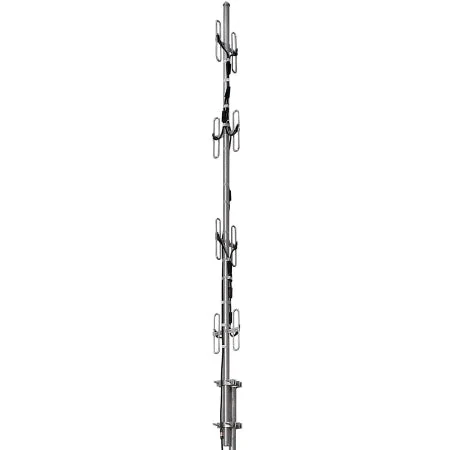
| Model | JC12-2550 |
|---|
| Frequency (manufacturer model field) | 2400-2700MHz |
|---|
| Bandwidth (manufacturer model field) | 2400-2700MHz |
|---|
| Gain (manufacturer model field) | 10 dBi |
|---|
| Frequency Range | 2400-2700 MHz |
|---|
| Gain | 10 dBi |
|---|
| Bandwidth | 2400-2700MHz |
|---|
| Polarization | Vertical |
|---|
| Input Impedance | 50 Ohms |
|---|
| Radiation Pattern | Omni-directional |
|---|
| VSWR - Equal To or Better Then | 2:1 |
|---|
| RF Power Handling Capacity | 200 Watts |
|---|
| Input Termination | N-Female |
|---|
| Antenna Materials | 6063T6 Aluminum & ABS |
|---|
| Mounting Hardware -Materials | Marine Grade Stainless Steel |
|---|
| Wind Rating | 170 Km/Hr. |
|---|
| Mounting Type | NATO 4 Holes or Customized |
|---|
| Overall Length | 1100 mm |
|---|
| Shipping Length | 1200 mm |
|---|
| Support Pipe O.D. | 50 mm |
|---|
| Radome Material | ABS or Fiber Glass |
|---|
| Radome Outer Diameter | 45 mm |
|---|
| Radome Length | 1000 mm |
|---|
| Gross Weight | 2 Kgs. |
|---|
| Operating Temperature | (-)30 to +70 Degrees Celsius |
|---|
| Storage Temperature | (-)40 to +80 Degrees Celsius |
|---|
| Humidity | 0 to 95% RH |
|---|
| Extreme 12 dBi Gain | Provides elite-level signal saturation and range for terrestrial electronic warfare missions. |
|---|
| Precision 7° Vertical Beam | Focuses energy toward the horizon, maximizing the effective range of vehicular and man-pack jammer systems. |
|---|
| High Power Capacity | Rated for 200 Watts of continuous-duty RF transmission. |
|---|
| NATO Interface Ready | Equipped with a standard NATO 4-hole pattern base for rapid installation on armored personnel carriers (APCs) and command vehicles. |
|---|
| Modular Versatility | Supports vehicle side-mounting, base station pole mounting, or direct man-pack equipment integration. |
|---|
| Pure Collinear Build | Uses high-grade brass elements to ensure a quiet signal path and maximum electrical efficiency. |
|---|
| Optional Spring Base | Can be supplied with a Bi-conical spring at the base for added mechanical flexibility during off-road tactical operations. |
|---|
| Electronic Warfare (EW) | The 200W rating and 12 dBi gain enable surgical, high-intensity jamming of S-band RCIED triggers and Wi-Fi-based communication nets. |
|---|
| C-UAS (Counter-Drone) | Specifically designed to disrupt 2.4 GHz UAV command, control, and video telemetry links. |
|---|
| Signals Intelligence (SIGINT) | The high-gain profile and clean noise floor of the brass elements allow for the interception of weak S-band data transmissions and high-speed spectrum scanning. |
|---|
| Thermal Tolerance | Operational from -30°C to +70°C, covering arctic to desert deployments. |
|---|
| Humidity Resilience | 0 to 95% RH rating for tropical and high-salinity maritime environments. |
|---|
| Wind Stability | Aerodynamic fiberglass profile rated for structural integrity in winds up to 150 Km/Hr. |
|---|
| Extreme Extended Range | Delivering a potent 12 dBi omnidirectional gain, this antenna provides a significantly larger electronic "denial zone" compared to standard 2 dBi or 5 dBi vehicular whips, allowing for greater standoff distances. |
|---|
| Precision Energy Focusing | The ultra-narrow 7-degree vertical beamwidth compresses RF energy toward the horizon. This ensures maximum power density is directed at ground-based triggers and low-altitude threats rather than being wasted in the sky. |
|---|
| High-Intensity Power Handling | Engineered for continuous-duty Electronic Attack (EA), it manages up to 200 Watts of RF power, supporting sustained signal saturation in contested environments. |
|---|
| Superior Mechanical Resilience | Constructed with a high-strength fiberglass radome and 6063T6 military-grade aluminum, it is built to survive high-speed tactical maneuvers, salt-fog corrosion, and physical impacts. |
|---|
| Standardized NATO Integration | The NATO 4-hole mounting pattern allows for immediate "bolt-on" installation across a wide fleet of armored personnel carriers (APCs), tanks, and tactical command vehicles. |
|---|
| Multi-Platform Versatility | Its modular design allows it to be transitioned from a vehicle side-mount to a man-pack unit or a fixed-site base station, providing a unified S-band solution for the entire unit. |
|---|
| Pure Collinear Efficiency | Utilizes large-diameter, in-phase brass radiating elements to ensure a quiet, PIM-free signal path and maximum electrical efficiency without the need for field tuning. |
|---|
| RCIED Defeat (S-Band) | Primary defense against Remote Controlled Improvised Explosive Devices that utilize 2.4 GHz Wi-Fi, Bluetooth, or high-band industrial remote triggers. |
|---|
| Counter-UAS (C-UAS) | A critical tool for disrupting the command, control, and video telemetry links of commercial and tactical drones operating in the 2.4 GHz ISM band. |
|---|
| Convoy Protection | Mounted on lead and rear vehicles to provide a high-power electronic shield for mobile tactical units and VIP motorcades. |
|---|
| Tactical Communication Denial | High-intensity jamming of adversary high-speed data networks, mesh radios, and wireless command-and-control (C2) nodes. |
|---|
| Signals Intelligence (SIGINT) | Used as a high-gain discovery antenna for intercepting and monitoring weak S-band signals or high-speed spectrum scanning. |
|---|
| Base Station Security | Permanent installation at Tactical Operations Centers (TOCs) or forward operating bases to deny unauthorized wireless access and drone incursions. |
|---|
| Frequency stated in title | 2400-2700 MHz |
|---|
| Gain stated in title | 12 dBi |
|---|
| Category | VHF, UHF & General-Purpose Antennas |
|---|